Table of Contents
TLDR:
- Hearing fades slowly with age, and most people miss it for years
- High sounds go first—then words start sounding blurry even at full volume
- Leaving it alone speeds up memory loss and cuts people off from their social life
- Hearing aids do not cure it, but they help a lot when fitted properly
- Advance Hearing Center in Cambodia can help—Singapore-trained team, proper equipment
- Book a hearing test in Cambodia and see where you stand
My uncle did not think he had a hearing problem. He thought everyone around him had started mumbling.
He turned the TV up. He moved to the front of the room at family events. He started texting instead of calling. And when someone finally sat him down and said, “You need to get your hearing checked,” he was genuinely surprised.
He is not unusual. Most people who come into Advance Hearing Center for the first time say some version of the same thing. They did not think it was that bad. They were just adapting.
That is what age-related hearing loss does. It does not knock on the door. It just slowly changes how you live, and you change with it without noticing.
So What Actually Happens to Your Hearing as You Age?
Deep in your ear, there are tiny hair cells. Thousands of them. Their job is to pick up sound and pass it to your brain as signals.
Over time they wear out. Slowly, over years and decades. They do not grow back. And when enough of them stop working, certain sounds start disappearing.
The first ones to go are usually high-pitched sounds. That is where most speech sounds live. Letters like s, f, th, sh. The sounds that separate one word from another.
So what you get is this weird in-between state. You can hear someone talking. The sound reaches you. But the words come out unclear, like someone speaking with their mouth half covered. You catch some, miss some, guess at the rest.
A lot of people spend years thinking they just need people to speak up. That is not it. Volume is not the problem. The hair cells that decode certain sounds are gone.
How Common Is This?
Very common. Genuinely very common.
About 1 in 3 people over 65 have some level of age-related hearing loss. By age 75 that goes up to about 1 in 2. A study done with older adults in Singapore found that more than 63% had measurable hearing loss.
And yet of those with significant hearing loss in that same study, only 7.5% were wearing hearing aids.
Think about that. Most people living with this are not getting help for it. They are just managing. Asking people to repeat themselves. Avoiding noisy places. Turning things up. Nodding along.
The Signs People Usually Miss
Age-related hearing loss does not feel like one big thing. It feels like a bunch of small irritations that seem unrelated.
Things like:
- You ask people to repeat themselves all the time and it is becoming a pattern
- You do fine one on one but group conversations are hard to follow
- You hear someone but cannot actually make out what they said
- Phone calls have gotten genuinely difficult
- You come home from dinner with friends and feel wiped out
- Birds, doorbells, the beep of a microwave have all gone quieter
- Subtitles are no longer optional
- Someone in your house is always turning the TV back down
None of these feel like hearing loss on their own. Together they usually are.
Things That Make It Happen Faster
Age is the main thing driving it. But other stuff speeds it up.
Noise over a lifetime is a big one. Years of working near loud machinery, concerts, earphones turned up. By the time someone hits 65, decades of noise and age have usually both left marks on the same audiogram.
Diabetes is another one most people do not connect to hearing. It damages small blood vessels all over the body. The inner ear has very small vessels. Less blood flow means the hair cells break down faster than they otherwise would.
High blood pressure works the same way.
Family history plays a role too. If your parents lost hearing in their 60s, there is a real chance you will follow a similar path.
Old ear infections, especially the kind that kept coming back in childhood, can leave scarring that makes things worse later on.
Some medications also cause inner ear damage over time. Certain antibiotics, some cancer drugs, long-term aspirin. If your hearing shifted after you started something new, bring it up with your doctor.
What Happens When People Do Not Do Anything About It
This is the part that gets left out of most conversations.
Your brain gets tired. When the sound coming in is patchy and incomplete, your brain fills the gaps all day. It guesses words. It pieces together sentences. It works much harder than it should. By evening you are exhausted in a way that does not make sense for what you actually did. That exhaustion is real and it comes from this.
Then there is the dementia link. This surprised a lot of people when research first showed it but it makes sense when you think about it. Your brain needs steady clear sound input to stay active. When it stops getting that, cognitive decline moves faster. A big study published in 2025 found that people who use hearing aids have meaningfully lower dementia risk than those who leave hearing loss untreated.
And then there is the social side. Noisy restaurants get avoided. Family gatherings feel overwhelming. You start saying no to things. First it is a practical choice. Then it becomes a habit. Then you realise you have not been out much lately and you are not totally sure when that happened.
Anxiety and depression show up more in people with untreated hearing loss than in those who deal with it. Being cut off from conversations every day, quietly, is its own kind of stress.
What Can Be Done
The hair cells are gone. Nothing brings them back. Age-related hearing loss does not reverse.
But how life sounds can change a lot.
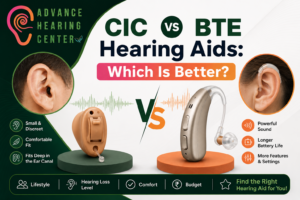
Hearing aids today are nothing like what older people wore 30 years ago. They process sound digitally. They figure out what is background noise and what is speech and they handle them differently. Many connect straight to your phone. Some adjust on their own when you walk from a quiet room into a noisy one. The smallest ones sit inside your ear canal and cannot be seen at all.
At Advance Hearing Center we fit every device to your specific audiogram. Not a general setting. Yours. We use real-ear measurement to check that the device is actually delivering what your ear needs, not just what a standard chart suggests. That check matters more than most people realise.
We work with Phonak, Signia, ReSound, Oticon, Starkey, and Rexton. All genuine devices, all covered by manufacturer warranty. You can read more about the different styles on our types of hearing aids blog, or take a look at our page on how to improve hearing in old age for more practical day-to-day information.
How Much Hearing Loss Is Too Much?
Audiologists put hearing loss into levels based on how many decibels of sound you need before you can hear something.
Level | Range | What it actually means day to day |
Mild | 26 to 40 dB | You struggle in noise, TV is a bit loud |
Moderate | 41 to 55 dB | Most conversations need repeating |
Moderately Severe | 56 to 70 dB | Even quiet rooms are hard to follow |
Severe | 71 to 90 dB | Only loud sounds get through |
Profound | 91 dB and above | Very little comes through even with a device |
Most people who walk into Advance Hearing Center for the first time are in the mild to moderate range. That is when treatment works best. Waiting until things are severe makes the whole process longer and harder.
What a Hearing Test Is Actually Like
A lot of people put off getting tested because they imagine something complicated or uncomfortable. It is neither.
You sit down with your audiologist for a few minutes first. They ask about your life, your work, how much noise you have been around, what has been bothering you. That conversation gives context before anything starts.
Then comes the actual test. Headphones on, quiet room. You press a button every time you hear a tone. The tones change in pitch and volume. At the end there is an audiogram that shows exactly where your hearing sits across all the main frequencies.
We also do speech testing at Advance Hearing Center. That checks how well you understand real words, not just tones. For age-related hearing loss the gap between detecting sound and actually understanding speech is often bigger than people expect.
Where it is relevant we also do tympanometry, which checks the middle ear. Sometimes what looks like age-related hearing loss has a middle ear part that can actually be treated.
The whole thing takes about 45 minutes. You leave with real answers.
Small Habits That Help
These are worth knowing whether you have a hearing aid or not.
Looking at the person you are talking to makes a bigger difference than people think. Faces and lips carry a lot. Use them.
Asking for clarity rather than volume helps. Asking someone to speak up does not fix much for age-related hearing loss. Asking them to speak clearly, face you, and slow down slightly does.
Turning off background noise during conversations is underrated. The TV running in the background while you are trying to talk makes everything harder.
Telling people about your hearing removes a lot of friction. Most people adjust naturally once they know. They stop trailing off at the end of sentences. They face you when they talk.
And if you have a hearing aid — wear it every day. Not just when you feel like you need it. Your brain adapts to clearer sound through consistent use. Wearing it occasionally stretches that adaptation out over months.
About Advance Hearing Center
Advance Hearing Center opened in Cambodia in 2018. We are connected to The Hearing Center Singapore, which has over 20 years in this field. Our audiologists trained in Singapore and work to the same standard.
We are an authorized provider for all the brands we carry. Every device is genuine and comes with a full manufacturer warranty. Every fitting uses real-ear measurement.
Most people who come to us for age-related hearing loss have been living with it quietly for a while. They did not realise how much had changed until they saw their audiogram. In most cases there is a real difference we can make. Not a cure. But better than where they were.
If this sounds familiar, the first step is just coming in. Visit Hearing Aids Cambodia to book with Advance Hearing Center.