Table of Contents
TLDR
- CIC (completely in canal) hearing aids sit deep in the ear canal and are nearly invisible.
- BTE (behind the ear) hearing aids sit behind the ear, more visible, but more powerful.
- CIC suits mild to moderate hearing loss. BTE covers mild all the way to profound.
- BTE batteries last longer, and the controls are easier for stiff or shaky fingers.
- CIC skips most Bluetooth and directional mic features, there’s just no room for them.
- BTE handles wind and humidity better. CIC clogs with earwax more easily.
- Neither style is better across the board. It comes down to your hearing loss, your ear shape, and how you actually live.
- A hearing test is really the only honest way to know which one is right for you.
Honestly, this is one of the first questions people ask us once they’ve accepted they need a hearing aid. Not “do I need one,” that part they’ve usually already worked out. It’s CIC vs BTE hearing aids, and which one they should actually walk out wearing. Both work. Both help people follow conversations again, hear the kettle boil, catch what their grandkids are saying. But they’re built differently under the hood, and that difference shows up in daily life more than most people expect. So let’s actually get into it.
What is a CIC hearing aid
CIC stands for completely in canal, and it’s exactly what it sounds like. It’s custom molded to fit deep inside your specific ear canal, so deep that most people wouldn’t spot it even standing right in front of you. Making one starts with an ear impression, which is basically how we get a mold of your ear so the device fits you and nobody else.
Because it’s tucked so far in and made so small, there isn’t much room left for extra hardware once the essentials are packed in. No big buttons. A tiny battery. Often no Bluetooth at all. What you trade features for is something almost nobody notices you’re wearing.
What is a BTE hearing aid
BTE, behind the ear, does what it says too. The main unit sits behind your ear, and a thin tube runs the sound down into your canal. Since there’s more physical room to work with back there, BTE devices can hold a bigger battery, a stronger amplifier, and a lot more electronics.
That extra space is exactly why we usually reach for BTE first when someone has severe or profound hearing loss. There’s simply more room in the case for the components that make that level of amplification possible without the whole thing squealing with feedback.
CIC vs BTE hearing aids, where they actually differ
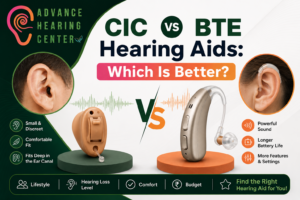
CIC wins on visibility, no real contest there. It sits far enough into the canal that even up close, people usually can’t tell it’s there. A BTE sits out in the open behind the ear, though the newer ones are far slimmer than the beige, clunky units a lot of people remember from years back.
Power is where it flips. BTE handles a much wider range, from mild loss right through to profound, while CIC is really built for mild to moderate loss. Push a CIC past what it’s designed for and you start hearing that annoying whistle, feedback, because the microphone and speaker are crammed so close together in such a tiny shell.
Battery life follows the same pattern. BTE uses a bigger battery, so changes are less frequent. CIC batteries are genuinely tiny, which means swapping them more often, and if your fingers aren’t as steady as they used to be, that gets old fast.
Features are where people are often surprised. A BTE has enough room inside for Bluetooth streaming, directional microphones, rechargeable batteries, buttons you can actually feel and press. A CIC skips most of that because there’s simply nothing left once the core parts are squeezed in.
Handling matters too, more than people think going in. If you deal with arthritis, shaky hands, or you’re just not that into fiddly small objects, BTE is a lot easier to manage every single day. CIC takes more precision to insert, remove, and clean properly.
Durability leans toward BTE as well. Its main electronics sit outside the canal, away from moisture and sweat. CIC sits right where earwax naturally collects, so it clogs more often and needs more regular servicing to keep working properly.
Wind is the one place CIC pulls ahead outdoors. Because it’s buried deep in the canal, it doesn’t catch as much wind noise as a BTE microphone sitting exposed behind the ear.
Technology level matters more than the style itself
Here’s something that gets lost in most CIC vs BTE comparisons. The style of the device, whether it sits in your canal or behind your ear, isn’t actually the biggest factor in how well you’ll hear. The technology tier inside the device is. A mid range BTE with basic processing can be outperformed in real world noisy situations by a premium CIC with better chip processing, even though the CIC is smaller and less powerful on paper. Before you lock in a style purely on looks or convenience, it’s worth asking what processing level you’re actually getting, since that’s often what separates a device you love from one you keep leaving in the drawer.
CIC hearing aids, pros and cons
There’s a lot to like about a CIC if discretion matters to you. It’s nearly invisible, the sound tends to feel a little more natural since your outer ear still plays a role in filtering it, and it copes well with wind outdoors. For a lot of first time wearers, not looking any different is honestly the deciding factor.
The catch is real too. It doesn’t have the power for severe or profound hearing loss. The battery is small enough that you’ll be changing it more often than you’d like. It skips most of the extra features like Bluetooth or directional microphones. Getting it in and out can feel fiddly at first. And because of where it sits, it’s more prone to getting clogged with earwax over time.
BTE hearing aids, pros and cons
A BTE earns its reputation mainly through range and reliability. It works across mild to profound hearing loss, so it’s rarely the wrong fit medically. Battery life tends to be longer, and a lot of models now come rechargeable. It’s easier to handle, adjust, and clean. There’s enough room inside for Bluetooth streaming and directional microphones, and it stands up better to moisture and earwax than smaller styles.
What you give up is discretion. It sits in plain view behind the ear. It can pick up more wind noise outdoors. There’s a bit of an adjustment period getting used to something resting on your ear all day, and depending on the fit, it can sometimes interact with glasses or face masks.
Who should actually choose CIC
CIC tends to fit people with mild to moderate hearing loss who care a lot about not looking like they’re wearing anything, and whose ear canal shape can actually take a snug custom fit (not every ear can, worth knowing that upfront). It’s also a reasonable starting point if you’re new to hearing aids and want something that doesn’t change how you look at all.
Who should actually choose BTE
BTE makes more sense once your hearing loss is on the more serious end, or if features like Bluetooth calls and music streaming genuinely matter to your day to day, or if fine motor tasks with tiny objects aren’t your strong suit. It’s also usually the go to for kids, since it can be adjusted as their hearing needs change and their ears keep growing.
Getting used to a new hearing aid
Whichever style you land on, give yourself real time to adjust. Your own voice will sound strange to you at first, sounds you’d tuned out for years, the fridge humming, footsteps, will suddenly be back. That’s normal. Most people need a couple of weeks before it stops feeling like a foreign object and starts feeling like part of getting dressed in the morning. Wearing it consistently, even for short stretches at first, gets you there faster than only putting it on for big events.
Common myths worth clearing up
A few things we hear a lot that just aren’t true. CIC hearing aids do not “hide” hearing loss the way some ads imply, they’re a tool, not a disguise. A more expensive hearing aid isn’t automatically the right one for you, fit and technology match matter more than price tag. And bigger isn’t automatically better either, a well matched CIC can outperform a poorly fitted BTE for the right person. The right choice really is personal, not a universal ranking.
Cost, does one cost more than the other
Price tends to track the technology inside more than whether it’s CIC or BTE. That said, CIC devices are custom shells made just for your ear, which adds to the manufacturing cost, while BTE devices come in a wider spread of price points since they’re less customized in shape. If budget is tight, it’s worth comparing both styles across a few technology tiers rather than assuming one style is simply cheaper by default.
A quick note on RIC and other styles
CIC and BTE aren’t the only two options. Receiver in canal (RIC) hearing aids land somewhere in between, smaller than a traditional BTE but with more room for features than a CIC. If neither one feels like quite the right fit after all this, it’s worth asking about RIC too. You’ll get a wider picture of what’s out there in our guide to types of hearing aids.
How hearing aids actually help either way
No matter which style you choose, the basic job is the same. A microphone picks up sound, a processor cleans it up and boosts the parts you’re missing, and a speaker sends the improved sound into your ear. If you want the fuller explanation, we’ve walked through it in how hearing aids work.
Taking care of your hearing aid
A CIC needs more frequent cleaning simply because of where it sits, right where wax collects. A soft brush and a quick wipe down each night makes a real difference over time. A BTE needs less daily fuss, but the tubing and moisture levels are still worth checking regularly. Either way, getting your device professionally checked through hearing aid servicing every few months catches small problems before they turn into a device that stops working when you need it most.
So, CIC vs BTE hearing aids, which one actually wins
Neither, honestly. CIC wins on discretion. BTE wins on power, features, and how easy it is to live with day to day. The real answer to CIC vs BTE hearing aids comes down to how severe your hearing loss is, how steady your hands are, whether Bluetooth streaming actually matters to you, and how much visibility genuinely bothers you. Anyone telling you one style beats the other for everyone is skipping the part where every ear, and every life, is different.
How we can help you decide
At Advance Hearing Center, we don’t steer people toward one style before we’ve actually looked at their hearing loss and their ear shape. Every recommendation starts with a proper check up, not a sales pitch. If you’re stuck weighing CIC vs BTE hearing aids and can’t quite decide, come find us for Hearing Aids Cambodia fittings and we’ll walk you through both, honestly, no pressure toward either one.
Still not sure whether CIC or BTE fits your hearing loss and your daily life. Come in for a hearing test and we’ll help you land on the style that actually works for you, not just the one that’s popular.