Table of Contents
TLDR: The medical term for a hearing aid is a hearing instrument or hearing assistance device (HAD). You’ll also see terms like amplification device, personal amplification system, or simply hearing device used by doctors and audiologists. Knowing what these mean helps you read your prescription without confusion, do better research, and have a smarter conversation with your audiologist. At Advance Hearing Center in Cambodia, our team deals with all of this daily — and we always explain things in plain language.
Most people just say “hearing aid” and move on. That’s totally fine in everyday life. But if you’ve ever sat in an audiologist’s office, read through a referral letter, or tried to Google something from your test report — you’ve probably run into terms you didn’t recognize. Hearing instrument. Auditory amplification device. HAD. PSAP. And you’re sitting there wondering if these are all the same thing or if you somehow need four different devices.
Good news: you don’t. But there are some differences worth knowing, especially if you’re shopping for a device or dealing with insurance paperwork.
The Official Medical Term for a Hearing Aid
In clinical settings, the term you’ll see most often is hearing instrument. Some professionals use hearing assistance device, shortened to HAD. The FDA officially classifies them as hearing aids — regulated medical devices built to help people with hearing loss hear better.
You’ll also come across a few other terms depending on who you’re talking to:
- Amplification device — a general term that just describes what it does (makes sound louder)
- Personal sound amplification product (PSAP) — this one’s important to know, because it is NOT a medical device. PSAPs are made for people with normal hearing who want to amplify sounds in specific situations, like hunting or birdwatching
- Auditory prosthetic — used mainly in medical literature, treating the device like a prosthetic limb that fills in for a function the body can’t do on its own
- Hearing device — a broad, non-specific term used by both patients and clinicians
- Otological device — refers to devices used in the ear (otology is the branch of medicine that deals with the ear)
The gap between a hearing aid and a PSAP matters more than most people realize. A PSAP is a consumer product. A hearing instrument is a regulated medical device. If you’re buying something online and it doesn’t clearly say it’s a regulated medical device, there’s a decent chance it’s a PSAP — and it’s probably not designed to actually treat your hearing loss.
Why Do Audiologists Use So Many Different Terms?
You’d think the medical world would just pick one term and stick with it. They haven’t, and honestly, the reason makes sense once you know it.
Audiology has changed a lot in the last 30 years. What was once a basic amplifier sitting behind your ear is now a digital computer processing sound in real time, connecting to your phone via Bluetooth, and in some cases, learning your preferences through AI. The technology grew — and the language around it grew with it.
Some audiologists prefer hearing instrument because it’s more accurate. These devices don’t just “aid” you — they process, filter, and adapt. Others stick with hearing aid because that’s what patients recognize and feel comfortable with. Neither is wrong.
When you come to Advance Hearing Center, our audiologists will walk you through all of this in plain language. But if you encounter these terms in a report or referral before your visit, now you’ll know what you’re looking at.
Types of Hearing Instruments You Should Know About
So what is the medical term for a hearing aid when it comes to specific styles? Each type has its own clinical name and abbreviation. Knowing them helps when you’re reading a recommendation or comparing options.
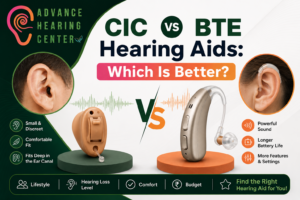
BTE — Behind-the-Ear The most widely used style. The main unit sits behind the ear, and a small tube carries sound into the ear canal. Works across a wide range of hearing loss, from mild to profound. Easy to handle, which is why it’s popular with children and older adults.
RIC / RITE — Receiver-in-Canal / Receiver-in-the-Ear Similar in shape to BTE but noticeably smaller. The receiver sits inside the ear canal itself rather than in the main housing. This gives a more natural sound and a more discreet look.
ITE — In-the-Ear Custom-made to fit the outer bowl of the ear. You can see it, but it’s easy to put in and take out — a real plus for people who have trouble with fine motor tasks.
ITC — In-the-Canal Smaller than ITE. Sits partly inside the ear canal. It’s a decent middle ground between visibility and ease of use.
CIC — Completely-in-the-Canal Fits deep inside the ear canal, so it’s nearly invisible from the outside. Good for mild to moderate hearing loss. Because it sits deeper in the canal, wind noise is reduced and using a phone feels more natural.
IIC — Invisible-in-Canal The most discreet option you can get. Custom-molded to sit entirely inside the ear canal. You genuinely can’t see it from the outside.
Two specialized devices worth knowing:
BAHA — Bone-Anchored Hearing Aid A surgically implanted post in the skull that sends sound through bone vibration, bypassing the outer and middle ear completely. Used for conductive or mixed hearing loss cases.
Cochlear Implant Not a hearing aid in the traditional sense. It’s a surgical device that directly stimulates the auditory nerve, bypassing the damaged parts of the inner ear entirely. Usually considered when hearing instruments no longer provide enough benefit.
Hearing Aid vs. Hearing Instrument vs. Auditory Prosthetic
People use these three interchangeably, but they do carry slightly different meanings.
A hearing aid is the standard everyday term — the one the FDA uses, the one your doctor uses when talking to you, the one on the packaging. It amplifies sound for people with hearing loss.
A hearing instrument is what audiologists and clinicians tend to prefer. It points to a more sophisticated, programmable device — something that does a lot more than simply boost volume.
An auditory prosthetic shows up in academic and medical literature. Think of it the same way you’d think of a prosthetic limb — it fills in for a function the body can no longer do on its own.
In real life, your audiologist’s prescription or report might use any of these. They’re all pointing to the same category of device. What actually differs is the model, the style, and how it’s fitted to your specific hearing loss.
How to Talk to Your Audiologist Without Getting Lost
You don’t need to memorize all of this before your appointment. But knowing a handful of key terms makes the whole process less stressful.
When you go for a hearing test — called an audiogram or pure-tone audiometry — you’ll get results measured in decibels (dB) across different sound frequencies. Those results tell your audiologist how severe your hearing loss is and what kind of amplification will help you most.
From there, you might hear about gain (how much amplification the device provides), frequency response (which pitches it boosts), and speech discrimination (how clearly you can understand spoken words). These are the core factors that determine which hearing instrument works for your ears and your lifestyle.
At Advance Hearing Center, we go through all of this step by step. You shouldn’t walk out of an appointment more confused than when you walked in. If something doesn’t make sense, just ask — that’s what we’re there for. If you’re not sure where to start, booking a hearing test is the right first move. We do full assessments at our Hearing Aids Cambodia clinic.
Does It Really Matter What You Call It?
For most day-to-day things? Not at all. Call it a hearing aid, a hearing device, or whatever you’re comfortable with.
But it starts to matter in a few specific situations:
- You’re researching online and different terms are giving you different (confusing) results
- A doctor’s referral uses clinical terminology you don’t recognize
- You’re trying to figure out if something you found online is a real medical device or just a consumer amplifier
- You’re applying for insurance or financial assistance that specifies certain device categories
- You’re looking at advanced options like bone-anchored devices or cochlear implants
Knowing the difference between a hearing assistance device and a PSAP could genuinely save you from wasting money on the wrong product. PSAPs aren’t designed to treat hearing loss. A properly fitted hearing instrument — programmed by an audiologist based on your specific audiogram — is a completely different thing.
Modern Hearing Instruments vs. What Your Grandparents Wore
A lot of people still have a mental image of hearing aids as big, beige, whistling things. That image is about 30 years out of date.
Today’s hearing instruments use digital signal processing (DSP). They don’t just make everything louder — they analyze what’s in the sound environment and make real-time adjustments. Many connect to your smartphone over Bluetooth. Some use AI to adapt to your listening preferences over time.
Here’s what’s actually different now:
- Size — devices are smaller than they’ve ever been. IIC models are completely invisible.
- Sound quality — digital processing handles speech-in-noise far better than anything analog could
- Connectivity — stream calls, music, and TV directly to your hearing instruments
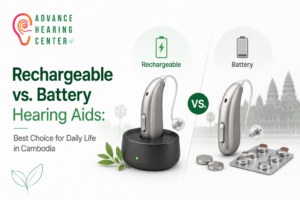
- Rechargeability — no more tiny batteries. Most modern devices charge overnight like a phone
- AI adaptation — some devices recognize your environment and adjust automatically without you touching anything
If someone in your life told you hearing aids are uncomfortable or don’t work, they were probably describing a device from a much earlier era. The gap between then and now is huge.
About Advance Hearing Center
Advance Hearing Center has been operating in Cambodia since 2018. We’re affiliated with The Hearing Centre in Singapore, which has been running for over 20 years. Our audiologists are Singapore-trained and work with premium digital hearing instruments from the top global brands.
Whether you’re starting with your first hearing test or you need hearing aid repair and servicing for a device you already own, we handle the full journey — from the initial assessment through fitting, programming, and long-term follow-up care.
Don’t let the terminology be the reason you keep putting this off. We’ll walk you through everything. The first step is just coming in for a test.