Table of Contents
TLDR: CIC (completely-in-canal) hearing aids are the smallest, most discreet style you can get. They sit completely inside your ear canal, making them approximately invisible. Prices usually range from $1,000 to $6,000+ per device relying on the brand, tech level, and whether they’re custom-fitted. They work best for mild to moderate hearing loss. Not ideal if you need strong amplification or have trouble handling small devices.
If you’ve been researching hearing aids and the idea of wearing something visible behind your ear puts you off, CIC hearing aids have probably caught your attention. They’re tiny. They sit deep inside your ear canal. Most people won’t even notice you’re wearing one.
But how much do they actually cost? And is the price worth it compared to other styles?
That’s what this guide covers. We’ll break down the CIC hearing aid price range, what drives costs up or down, which brands make them, and who they genuinely suit — so you can make a proper decision rather than just guess.
At Advance Hearing Center, we work with a lot of patients who come in specifically asking about CIC devices. Usually because they want something discreet, or someone’s told them they’re “basically invisible.” Both are fair reasons. But cost is always part of the conversation, so let’s start there.
What Is a CIC Hearing Aid?
CIC stands for completely-in-canal. It’s exactly what it sounds like — the whole device sits inside your ear canal, not behind your ear, not in the outer bowl of your ear. Inside the canal.
Because of where they sit, CIC hearing aids are nearly unworkable to see from the outside. The only evident part is a tiny removal cord (often called a pull string) that lets you take the device out. Even that’s delicate enough that most people miss it completely.
They’re custom-made for your ear. An audiologist takes a mould of your ear canal, sends it to the producer, and the device gets constructed to fit your specific anatomy. That’s part of why they cost more than off-the-shelf choices.
CIC devices work by picking up sound over a tiny microphone, processing it digitally, expanding it based on your individual hearing profile, and delivering it instantly into your ear canal. Because they take a seat so close to the eardrum, the sound tends to sense more natural and requires less expansion than a device worn further away.
CIC Hearing Aid Price: What to Expect
Let’s get straight to the numbers, because this is what most people actually want to know.
CIC hearing aid prices generally fall between $1,000 and $6,000+ per device, depending on the brand, technology tier, and where you buy it. Here’s a rough breakdown:
Technology Level | CIC Price Range (Per Device) |
Entry-level / basic digital | $800 – $1,500 |
Mid-range | $1,500 – $3,000 |
Premium / advanced | $3,000 – $6,000+ |
Entry-level CIC devices handle basic amplification well. They’ll help you hear conversations in quiet environments, which is enough for a lot of people with mild loss. Mid-range models add features like noise reduction and multiple listening programs. Premium models bring in advanced sound processing, some with AI that adapts in real time to where you are and what you’re doing.
Worth knowing: CIC devices tend to sit at the higher end of hearing aid pricing overall. Partly because they’re custom-made, partly because fitting a full digital system into something that small takes more engineering than a larger device.
If budget is a real constraint, check what our hearing aids options look like across different styles there may be a more affordable path to better hearing than you’d expect.
What Makes CIC Hearing Aid Price Go Up or Down?
A few things have the biggest impact on what you end up paying.
1. Technology Level
This is the biggest factor by far. A basic CIC device amplifies sound and not much else. A premium one uses AI processing, recognises different sound environments, suppresses background noise, and adjusts itself automatically. The gap in listening experience between entry-level and premium is real — especially in noisy environments like restaurants or busy offices.
2. Brand
Different brands price their CIC range differently. Phonak, Signia, Oticon, Starkey, Widex, and GN ReSound all make CIC models. Premium brands with strong research and development behind them tend to charge more. But they also tend to deliver more consistent results.
3. Custom Fit vs. Ready-to-Wear
Professionally fitted CIC devices are custom-made from a mold of your ear. They cost more but fit better, stay in place more securely, and deliver more accurate amplification because they’re programmed specifically to your audiogram.
Over-the-counter CIC devices exist too — they use universal-fit silicone tips rather than a custom mold. They’re cheaper but the fit is less precise, sound quality is often lower, and they can be uncomfortable over extended wear.
4. Features
Things like rechargeable batteries, Bluetooth connectivity, tinnitus management features, and compatibility with smartphone apps all add to the cost. Most basic CIC devices still use disposable batteries (size 10) because there simply isn’t room for a rechargeable cell inside. Some newer models have started offering rechargeable CIC options, but they tend to sit at the premium end.
5. What’s Included in the Price
Some clinics bundle the hearing test, fitting, follow-up appointments, and warranty into one price. Others price the device separately from services. Always ask what’s included before comparing quotes — an apparent $500 difference between two clinics might disappear once you account for aftercare.
CIC Hearing Aids by Brand: What They Cost
Here’s a general guide to how major brands price their CIC range. These are approximate figures and vary by region and clinic.
Phonak (Virto series) Phonak’s CIC models fall under the Virto line. Their Virto Infinio and Virto Paradise models are among the most well-known CIC hearing aids on the market. Prices range from around $2,000 to $4,500+ per device for premium tiers. The Virto Titanium models (made from titanium shell for a thinner wall) sit at the higher end.
Signia (Insio series) Signia’s Insio CIC range includes some excellent options. The Insio IX and Silk models offer their Own Voice Processing (OVP) technology which helps reduce the “echo-in-a-barrel” effect that some CIC users notice. Price range typically $1,800 to $4,000+ per device.
Starkey Starkey has been making custom CIC hearing aids for decades. Their models include health-tracking features and fall detection on premium tiers. Pricing typically runs from $1,500 to $4,500+ per device.
GN ReSound ReSound’s custom CIC line offers solid sound quality with good connectivity. Pricing similar to Signia — roughly $1,800 to $4,000 per device.
Oticon Oticon’s Own range includes CIC options with their BrainHearing technology. Expect $2,000 to $4,500+ per device at premium tiers.
If you want to explore how these brands compare in your specific situation, take a look at what CIC hearing aids in Cambodia are available at Advance Hearing Center, where we carry several of these major brands.
CIC vs Other Hearing Aid Styles: How the Price Compares
You might be wondering whether you’re paying a premium for CIC just because of the discretion factor. Here’s how it compares:
Style | Visibility | Price Range (Per Device) | Best For |
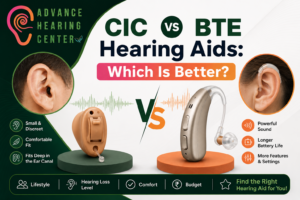
BTE (Behind the Ear) | Most visible | $800 – $4,000 | Moderate to profound loss |
RIC (Receiver in Canal) | Low visibility | $1,200 – $5,000 | Mild to severe loss |
ITE (In the Ear) | Moderate | $1,500 – $4,500 | Mild to severe loss |
ITC (In the Canal) | Low visibility | $1,500 – $4,500 | Mild to moderate loss |
CIC (Completely in Canal) | Almost invisible | $1,000 – $6,000+ | Mild to moderate loss |
IIC (Invisible in Canal) | Invisible | $2,000 – $6,000+ | Mild to moderate loss |
RIC hearing aids often come close to CIC on discretion while offering more features (rechargeable options, better Bluetooth, stronger amplification) at a similar or sometimes lower price. If absolute invisibility isn’t a strict requirement, it’s worth comparing both styles before deciding.
For a broader look at all your options, our guide on types of hearing aids breaks down every style with honest pros and cons.
Pros and Cons of CIC Hearing Aids
It’s worth being upfront about this — CIC devices aren’t the right answer for everyone.
What’s good about them:
- Nearly invisible — most people won’t know you’re wearing one
- Sit close to the eardrum, which can improve naturalness of sound
- Less wind noise than behind-the-ear styles (the ear canal shields the microphone)
- Outer ear still captures sound naturally, improving spatial awareness
- Comfortable for glasses wearers since nothing sits behind the ear
What’s not so good:
- Smaller battery life — size 10 batteries need changing every 3 to 7 days typically
- Not suitable for severe or profound hearing loss — there’s a limit to how much amplification fits in a device this small
- Harder to handle for anyone with arthritis, stiffness, or dexterity issues — they’re tiny
- More vulnerable to moisture and earwax buildup because of how deep they sit
- Most models don’t have Bluetooth or rechargeable batteries
- Custom fitting means a longer lead time to get your device
Who Should Consider a CIC Hearing Aid?
CIC hearing aids are a genuinely good fit for people who:
- Have mild to moderate hearing loss (not severe or profound)
- Want the most discreet option available
- Are active and don’t want a device that moves around easily
- Don’t need strong Bluetooth connectivity as a must-have
- Can handle small devices comfortably
- Don’t have significant dexterity challenges
- Wear glasses and find behind-the-ear devices uncomfortable
They’re not a great fit if you have severe hearing loss, need rechargeable convenience, require Bluetooth for phone calls and streaming, or have small ear canals that can’t accommodate a custom device.
If you’re unsure which side of that line you fall on, a proper audiometry test is the most reliable starting point. Your audiogram tells you the degree and type of hearing loss you have — and that determines which styles are actually suitable for you, before you spend a single dollar.
How to Get the Most from Your CIC Hearing Aid Investment
Once you’ve made the decision to go CIC, a few things make a real difference to how much value you get out of it.
Get properly fitted. A CIC hearing aid that doesn’t fit your ear canal properly will be uncomfortable, may fall out, and won’t deliver accurate amplification. Custom fitting from a qualified audiologist isn’t optional — it’s what separates a device that helps from one you stop wearing after a month.
Commit to the adaptation period. New CIC users often find sounds feel slightly different at first — your own voice may echo a little, background noise may feel more prominent. This settles down. Give yourself 4 to 6 weeks of consistent use before deciding whether it’s working.
Clean regularly. Because CIC devices sit deep in the canal, they pick up more earwax than other styles. A simple daily wipe and weekly cleaning routine keeps them performing well and extends their lifespan.
Keep up with hearing aid servicing. Regular professional servicing catches minor issues before they become expensive repairs. Most good clinics build this into their aftercare package.
Consider a hearing aid repair plan. CIC devices are complex, and sitting inside the ear canal means they get more exposure to moisture and earwax. Knowing you have hearing aid repair coverage gives you peace of mind and keeps long-term costs manageable.
How to Choose the Right CIC Hearing Aid
Don’t start with the brand. Start with your hearing profile.
Your audiogram will tell you how much hearing loss you have at different frequencies. That determines the minimum amplification a device needs to provide. Once you know what you need audiologically, you can look at which CIC models hit that target — and then compare brands, features, and prices within that range.
A few practical questions worth asking yourself:
- How important is Bluetooth/streaming to me?
- Can I manage small battery changes every few days, or would rechargeable be better?
- Am I going to wear this in noisy environments regularly?
- Do I have any dexterity issues that might make handling a tiny device difficult?
Honest answers to these questions narrow the field considerably. What’s left is a much shorter list of options that actually fit your life — and that’s when comparing prices makes sense.